The quiet power of the person who connects teams
One of the most useful people in a company I worked at had no special title. They just knew who to call.
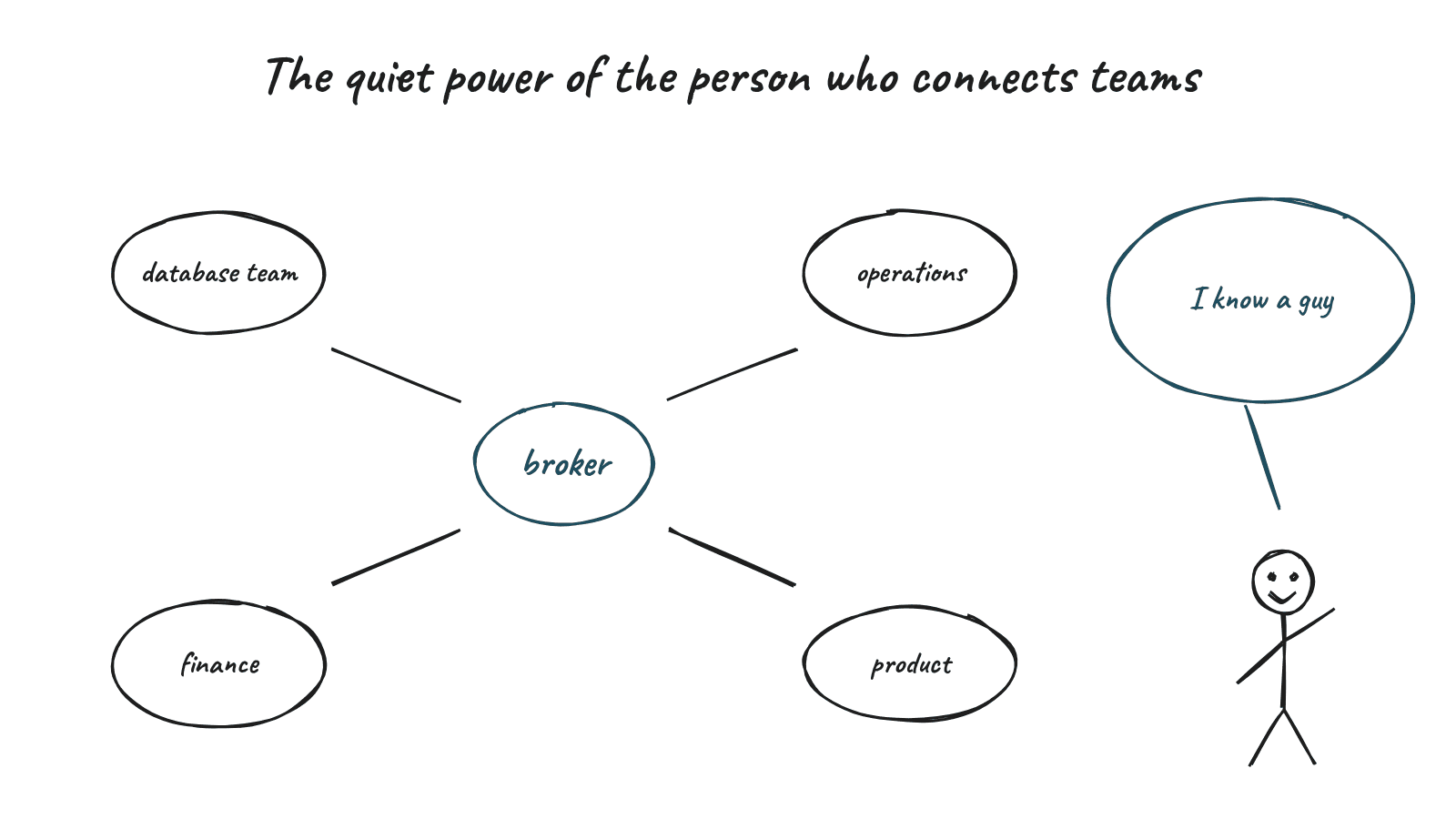
In every company I have worked in, there was someone who knew everybody. Not in a loud, networking event way. They simply had coffee with the database team, lunch with operations, and somehow also knew the people in finance.
When something got stuck, people said, "Ask her, she will know who to talk to."
For years I thought of this as a nice personality trait. Organisational behaviour taught me it is a structural position with real power. (Their real job title should have been Chief Coffee Officer.)
Brokers and structural holes
The idea goes like this. Organisations are made of clusters. Teams, departments, offices. Inside a cluster, people talk a lot. Between clusters, there are gaps. Some researchers call them structural holes.
A broker is someone who bridges those gaps. They have relationships in two or more clusters that do not otherwise connect. Because of that, they see information earlier, they can combine ideas from different worlds, and they can get things done that others cannot.
Where I saw it in banking
When I worked on core banking and switching integrations, the hardest problems were never purely technical. They sat between the bank's operations team, the switching vendor and the network partner. Each group had its own language and its own priorities.
The projects that went smoothly always had a broker. Often it was a senior engineer who had once worked at the vendor, or an operations lead who had spent time in IT. They could translate. They knew who to call at 11pm.
The projects that struggled had nobody in that position. Every question travelled up one hierarchy and down another. A one hour fix took a week.
Brokers are fragile
Here is the uncomfortable part. Brokers are often underrated in formal structures. Their work does not show up neatly in a ticket system. They spend time in meetings that are "not their job." When reorganisation comes, they can look like overhead.
Lose them and you lose the bridges. Suddenly teams that used to cooperate start writing formal requests to each other.
How I use this now
On larger programmes, including large scale digital transformation and migration, I now do a simple exercise early on. I draw the groups involved and ask who connects them. Where there is no bridge, I either assign one deliberately or create forums where people can build those ties.
I also try to protect the natural brokers. Give them credit. Give them time. Make their role visible to their managers.
A note on AI agents
AI agents are getting good at summarising across documents and systems. In a way, they are becoming information brokers. That is useful. But they do not have relationships. They cannot get a favour from someone in another department at midnight. Human brokers still matter, maybe more than before.
I sometimes wonder if I am that person for anyone. Then I check my calendar and see the same five names. Work in progress.