Pricing your platform team like a product
Platform teams build the plumbing everyone uses, and every budget season they get asked to be cheaper plumbing.
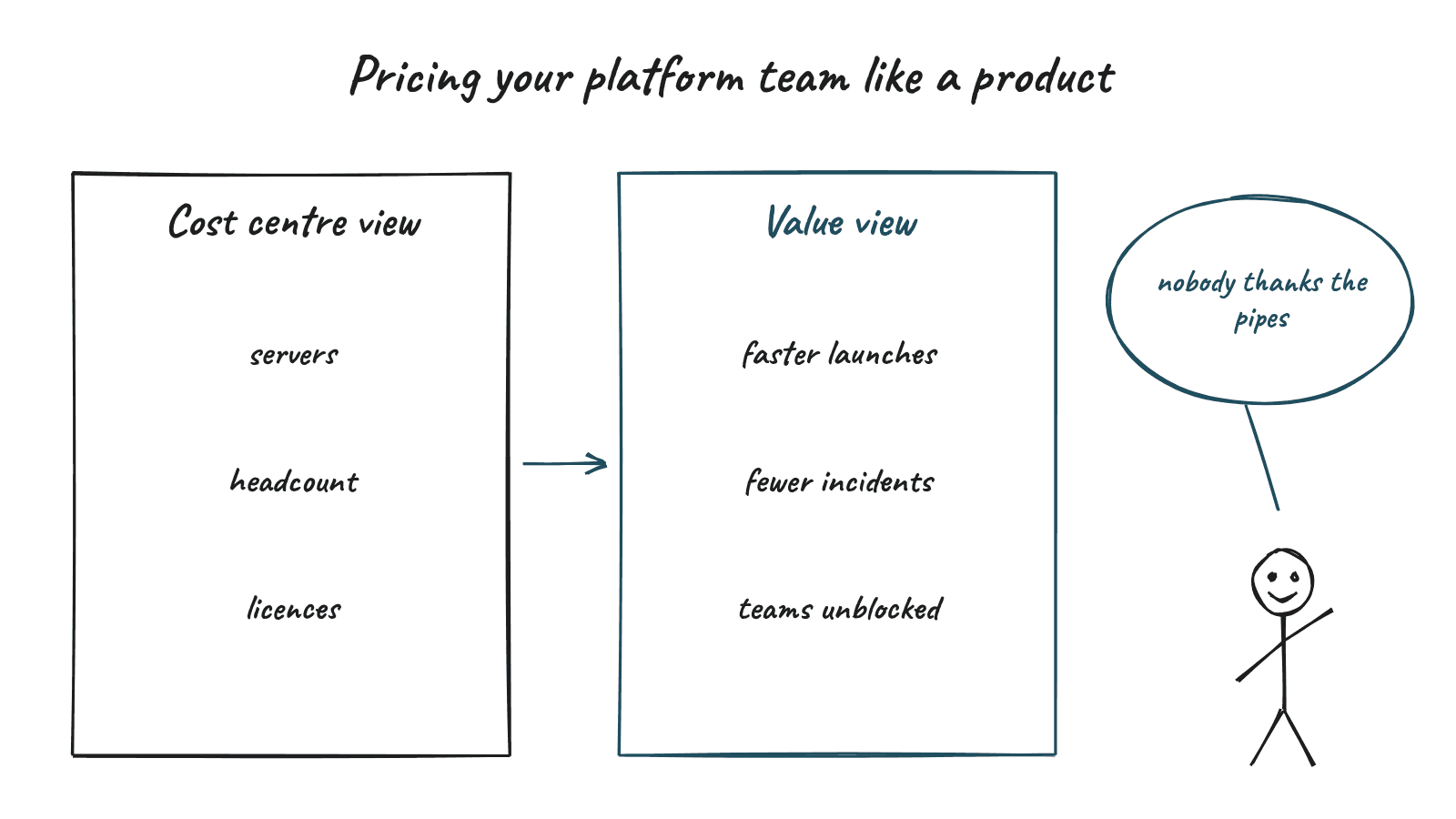
Platform teams have a branding problem. They build the plumbing everyone depends on, and in return they get described as a "cost centre." Budget season arrives, and the first question is always how to make them cheaper.
I have been on both sides of this. I have run platform work and I have been the business stakeholder asking why it costs so much. The marketing and pricing part of my EMBA gave me a better way to think about it.
Cost plus versus value
There are a few ways to set a price. One is cost plus. Add up what it costs, add a margin, done. Another is value based. Figure out what the thing is worth to the customer and price from there. Nobody has ever thanked a pipe. I have checked.
Most internal platforms are priced like cost plus, even when no money changes hands. The conversation is "this cluster costs this much per month." That frames the platform as an expense to be minimised.
A value based conversation sounds very different. "This shared payment gateway lets product teams launch a new payment method in two weeks instead of three months." Now the platform looks like a speed machine instead of an expense.
Use value and exchange value
One idea I found useful is the difference between use value and exchange value. Use value is what the customer actually gains from using something. Exchange value is what they pay for it, or what it seems to cost.
With internal platforms, the use value is often huge and invisible. Nobody notices the incident that did not happen or the compliance audit that passed easily. The exchange value, the cloud bill and the headcount, is very visible.
Your job as a platform leader is to make the use value visible.
How I do this now
When I present a platform budget, I try to answer three questions in business terms.
- What would each team spend if this platform did not exist? Engineers, time, licences, risk.
- How much faster do teams move because of it? Weeks saved per launch is a powerful number.
- What risks does it remove? Security, regulatory findings, downtime.
In fintech microservices work, a shared observability stack once looked expensive on paper. When we estimated how many hours each squad would spend building their own logging and alerting, the platform suddenly looked cheap.
A warning about overselling
Value based thinking can tip into fantasy. If you claim your platform saves a billion rupiah a year, someone will ask you to prove it. Be conservative. Use ranges. Show your assumptions. A credible small number beats an exciting large one.
AI platforms will face this soon
Many companies are now building shared AI agent platforms. They will face the same problem. The GPU bill will be very visible. The value, faster work across many teams, will be spread thin and hard to see. Leaders who frame it early in value terms will keep their funding. Those who report only cost will be asked to cut.
I resisted this idea for a while. Talking about value felt like marketing, and I am an architect. But plumbing that nobody can see the value of is the first thing on the cut list.