Put the answer in the first line
The most important sentence I ever wrote at work was hiding in paragraph nine.
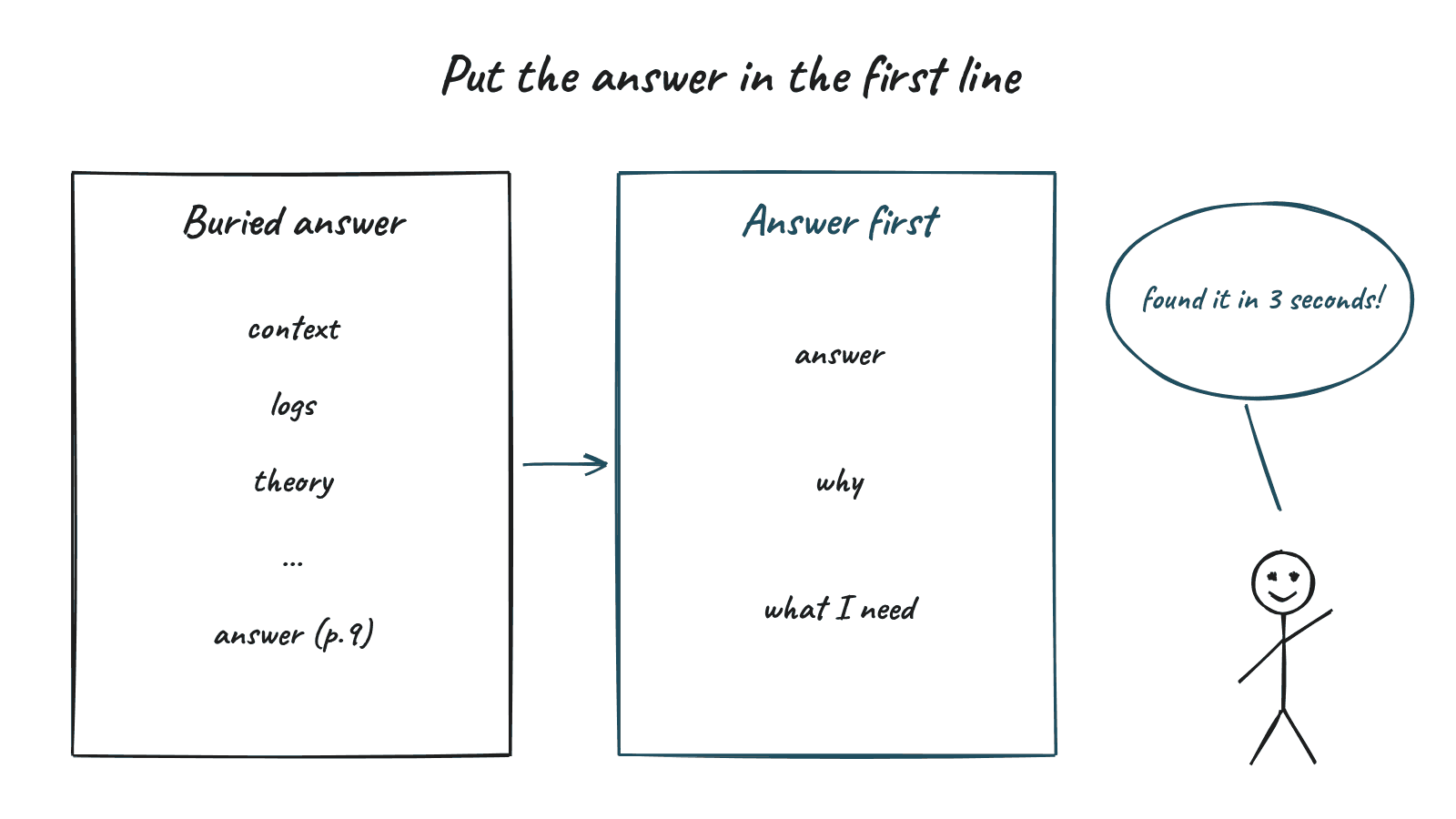
Early in my banking days I wrote an email about a failed batch job. It was beautiful. It had a timeline, log extracts, a theory about the root cause, and a careful list of what we had already ruled out. It was also eleven paragraphs long.
My manager replied with one line. "So do we need to delay the release or not?"
The answer was no. It was in paragraph nine. (I suspect most managers read the first line and then the signature. I know I do now.)
The reader is busy, not lazy
I used to think people who skimmed my messages were not paying attention. Then I became the person receiving forty status updates a day, and I understood. Senior people are triaging, and lazy has nothing to do with it. Every message gets a few seconds to prove it needs more.
If your first line does not tell them what you need, the message goes into the "later" pile. Later often means never.
One idea from my business communication classes put words to something I had learned the hard way. Clear writing starts with knowing your single main point before you type anything. If you cannot say it in one sentence, you are not ready to write. You are still thinking, and that is fine, but do the thinking in a notebook, not in someone's inbox.
A simple shape that works
These days most of my messages follow the same shape.
- The answer or the ask, in one sentence.
- Why, in two or three short points.
- What happens next, and who owns it.
- Details below a line, for anyone who wants them.
So the batch job email would become: "No release delay needed. The batch failure was a config issue in the test environment and does not affect production." Then the reasons. Then the long, beautiful investigation, for the two people who actually want it.
It feels rude at first. It is not. It is respect for the reader's time.
Engineers resist this
Engineers often build their messages like a proof. Premises first, conclusion last. That works for a maths exam. It does not work for a release decision at 5pm on a Friday.
There is also a fear behind it. If I put the conclusion first, someone might challenge it before seeing my reasoning. True. But that is a good thing. If the conclusion is wrong, you want to find out in the first minute, not after everyone has read eleven paragraphs.
AI agents made me better at this
I now use AI agents every day, and they forced the habit on me. When I give an agent a vague brief, I get vague work back. When I start with "the goal is X, and done looks like Y," the output improves immediately.
People are the same. A clear first line is a brief. It tells the reader what to do with everything that follows.
Try it this week
Take your next three long messages and move the last paragraph to the top. Read it again. In most cases you will notice the conclusion was there all along, sitting at the bottom like a shy guest at a party.
It is a small habit. I still forget it on busy days, and I can tell, because those are the emails nobody answers.
Funny thing is, I wrote this whole post with the point at the top, then caught myself trying to add a long background section above it. Old habits.